Product highlights
- NASA explicitly identifies Johnson Space Center as designer/builder and R5 as Valkyrie. The 2013 DRC appearance is a research milestone, not a commercial-sale date; later hand, ankle and sensing changes are described without certifying all subsequent versions.
- NASA’s article and two-page fact sheet agree on 300 lb, 6 ft 2 in and 44 DOF. The 1.8 kWh energy capacity is distinct from about one-hour battery runtime; wall power is an alternative, not infinite battery endurance or a recharge duration.
- Simplified hands have three fingers and a thumb with service disconnects. Seven arm joints and other subsystem inventories are not recomputed into a different total; historical sensing and degraded-environment design goals do not establish numerical navigation accuracy, ingress certification or delivered spaceflight use.
Product sources
- NASA — R5 - NASA · Manufacturer source · Checked 2026-11-03
- NASA — National Aeronautics and Space Administration · Manufacturer source · Checked 2026-11-03
Description
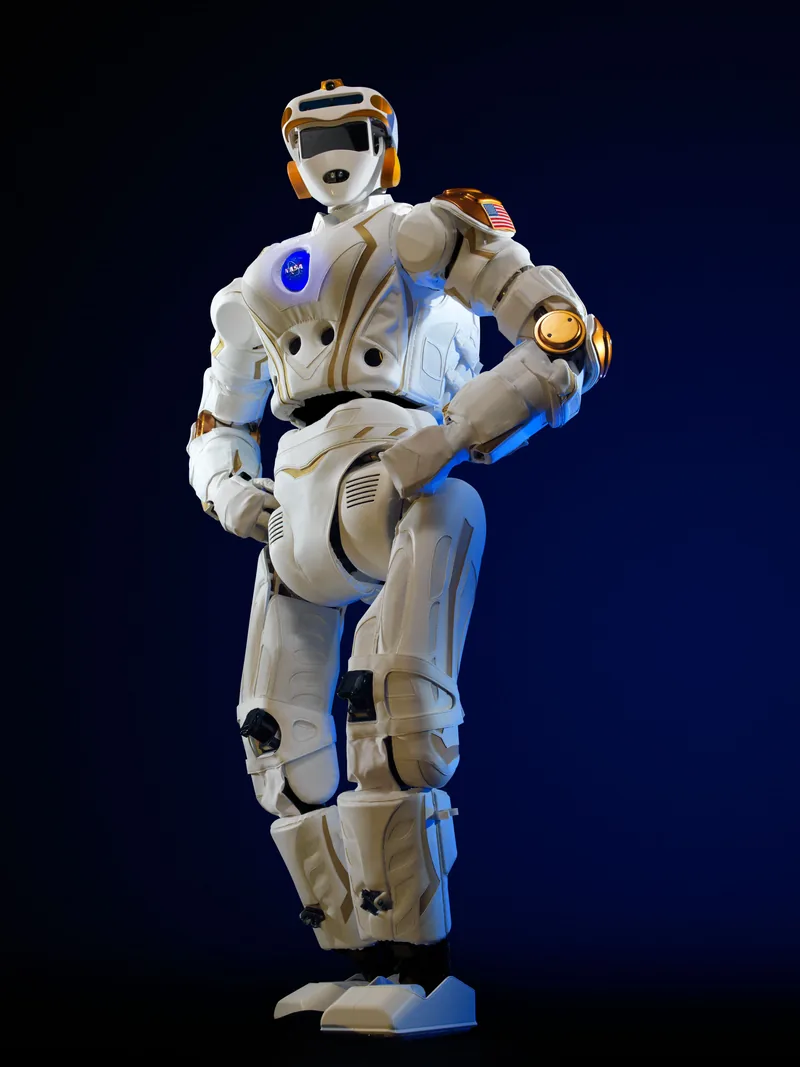
NASA Johnson Space Center humanoid research robot, also named R5, built for the 2013 DARPA Robotics Challenge. The NASA article and fact sheet document a 300 lb, 6 ft 2 in, 44-DOF configuration with about one-hour battery operation or wall power. Apptronik describes team contributions to its actuators and controls; those contributions do not make Valkyrie an Apptronik-manufactured product.
researchdev-platformhumanoid
Specifications
Sources cover the marked fields only. Unmarked values have not been checked in this review; manufacturer figures are not independent test results.
| WeightSource review · | 300 lb (NASA R5 documented configuration) |
| SizeSource review · | 6 ft 2 in standing height (NASA R5 documented configuration) |
| Battery LifeSource review · | About 1 h on battery; wall power is an alternative |
| Max RuntimeSource review · | About 60 min on battery; workload unspecified |
| HandsSource review · | Simplified humanoid hands: 3 fingers and a thumb; quick-disconnect attachment |
| Degrees of FreedomSource review · | 44 as stated in NASA article and fact sheet |