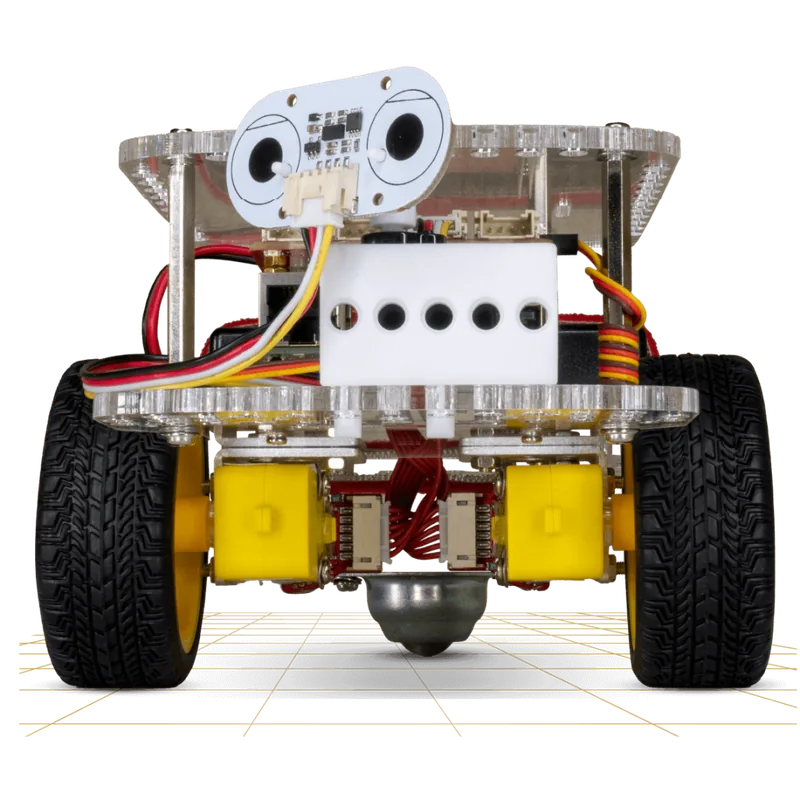
Product highlights
- GoPiGo 2 has a separate technical-specification section: 65 mm wheels, two optical encoders with 18 pulse counts per rotation, and 7–12 V input. These are distinct from GoPiGo 3’s 66.5 mm wheels and magnetic encoder/gear-reduction figures.
- One I 2C, one serial, one analog and one digital/PWM port are listed for GoPiGo 2. Example current consumption of 300–500 mA idle and 800 mA–2 A under motors/camera/servo load is qualified by Raspberry Pi Model B+ and is not converted into runtime.
- The original developer’s tutorial page explicitly covers older GoPiGo 1/2 hardware, with Python and Scratch projects. Current Modular Robotics attribution does not make the historical hardware a different brand duplicate; generic sidebar prices, release years and current availability are not promoted.
Product sources
- Modular Robotics / Dexter Industries — Dexter Industries generation-specific GoPiGo2/3 technical specifications · Manufacturer source · Checked 2026-11-02
- Modular Robotics / Dexter Industries — historical GoPiGo2 tutorials and GoPiGo1/2 scope · Manufacturer source · Checked 2026-11-02
Description
Historical GoPiGo generation documented separately from GoPiGo3. The original developer’s technical page specifies 7–12 V operating input, 65 mm wheels and two optical encoders with 18 pulse counts per rotation. It lists one I2C, one serial, one analog and one digital/PWM interface. Current draw examples use a Raspberry Pi Model B+ and do not establish battery runtime. The tutorial page supports Python and Scratch examples for older GoPiGo1/2 hardware.
educationalprogrammablecodingraspberry-pihistorical
Specifications
Sources cover the marked fields only. Unmarked values have not been checked in this review; manufacturer figures are not independent test results.
| Drive modeSource review · | Programmable wheeled Raspberry Pi robot with optical wheel encoders |