Product highlights
- The 14.5 kg vehicle mass excludes batteries and instruments; the 15 kg allowance combines batteries with payload. The 3 m/s maximum uses two batteries with no payload, rather than a fully loaded survey configuration.
- At 1 m/s and about 30 W without payload, the table lists 18/36/50/62 hours for two/four/six/eight batteries. The largest setup is 2,128 Wh; optional solar indefinite operation is not battery-only endurance.
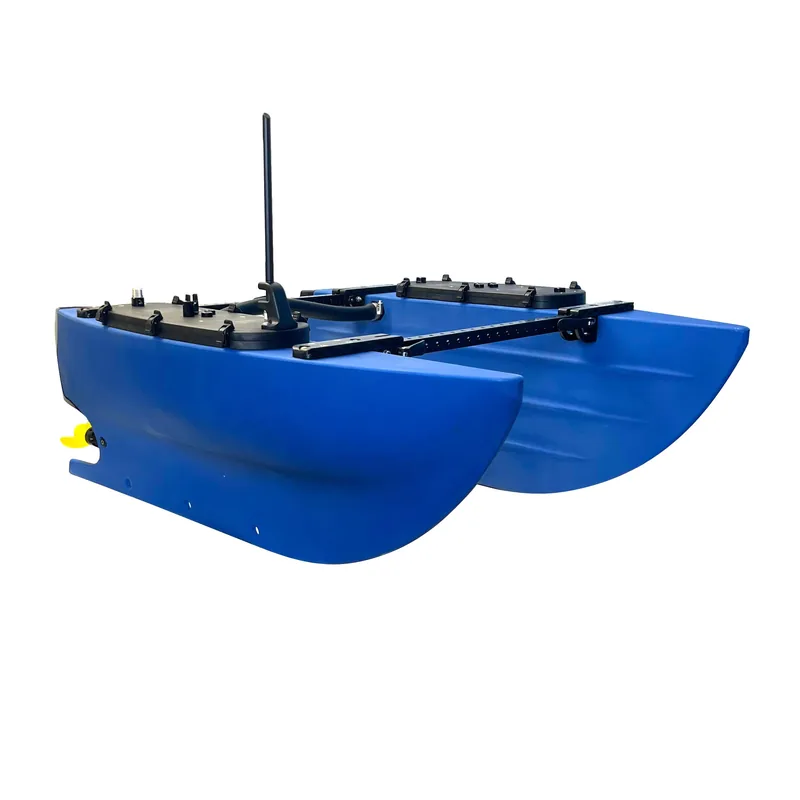
- Twin M200 motors and weedless propellers steer through differential thrust. Overall table dimensions are 120 × 93 × 46 cm deployed and 120 × 71 × 24 cm folded; packaging dimensions remain separate.
- GPS, Navigator, ArduRover and BlueOS support manual, waypoint, guided and position-hold operation. The operator guide defaults non-Auto telemetry loss to motor-stopping Hold, while Auto ignores that failsafe; return-home behavior depends on configuration.
- Standard-antenna telemetry/control is listed up to 250 m; optional directional antennas exceed 800 m under suitable conditions. Communication reach is not sonar survey depth, guaranteed mission range or collision avoidance.
- The manufacturer starting price is 4,400 USD before tax. Batteries, charger, computer and selected sonar/radio accessories need the appropriate supplied-system configuration; the starting vehicle price is not a complete survey package.
- Payload interfaces and BlueOS support integrating survey instruments, cameras and communications. Optional sonar accuracy, a BaseStation charge indication and 320 mm maximum loaded draft are not vehicle navigation accuracy, vehicle charge duration or a diving-depth rating.
Product sources
- Blue Robotics — BlueBoat current product and conditional endurance tables · Manufacturer source · Checked 2026-11-02
- Blue Robotics — BlueBoat linked January 2025 datasheet · Manufacturer source · Checked 2026-11-02
- Blue Robotics — BlueBoat operating modes and failsafes · Manufacturer source · Checked 2026-11-02
Description
BlueBoat is a surface survey/research catamaran with differential thrust, two M200 motors and configurable instruments. Its 14.5 kg mass excludes batteries and payload; the 15 kg allowance combines both. GPS/ArduRover/BlueOS support waypoint, guided and position-hold modes. Listed endurance ranges from 18 to 62 hours at 1 m/s and no payload as battery count rises from two to eight; 3 m/s top speed uses two batteries without payload. Communications-loss behavior depends on mode and failsafe parameters, rather than universally returning home. Folded and deployed sizes and optional sonars, radios and solar equipment retain separate scope.
Specifications
Sources cover the marked fields only. Unmarked values have not been checked in this review; manufacturer figures are not independent test results.
| PriceSource review · | From 4,400 USD; tax excluded; options, batteries, charger and laptop additional; shipping not established |
| WeightSource review · | 14.5 kg without batteries or payload |
| SizeSource review · | 120 x 93 x 46 cm deployed; 120 x 71 x 24 cm folded (L x W x H) |
| Battery LifeSource review · | 18/36/50/62 h with 2/4/6/8 batteries at 1 m/s (~30 W), no payload |
| Max RuntimeSource review · | 62 h with 8 batteries (2,128 Wh), 1 m/s (~30 W), no payload; highest listed battery configuration |
| Drive modeSource review · | Differential thrust; 2 M200 motors with weedless propellers |
| PayloadSource review · | 15 kg combined batteries and payload |
| SpeedSource review · | Maximum 3 m/s with 2 batteries, no payload |
| TerrainSource review · | Water surface; survey and robotics-development catamaran |